

2 min readUpdated October 2026
How to make friends in your 20s.
At school and uni, friends came with the timetable. Then the timetable ended. Here’s how to rebuild the “same people, again and again” that made it easy.
- 5-minute read
- Practical
- Free
How often could you see someone new?
It’s more common than people admit, especially after school or university ends or after a move. The structure that made friendship automatic disappears, and it takes deliberate, repeated contact to rebuild it.
How long until you’re friends?
Pick how often you could see someone new. The research says friendship is mostly hours together.
At that pace you’d be friends in about 11 months.
Based on Jeffrey Hall’s 2018 study: about 50 hours together to become casual friends, about 90 to become friends and more than 200 to become close friends.
Plan the first one.
Pick one thing, one day this week and one person to ask. That’s the whole plan.
1What sounds good?
2Which day?
3Who with?
The short version
- 01
Rebuild the timetable
Find one weekly thing with the same people.
- 02
Say yes twice
The second invitation is where friendships start.
- 03
Be the one who asks
Most people are waiting for someone else to suggest it.
- 04
Give it two months
Acquaintance to friend takes weeks, not days.
Why it gets harder after school or uni
For years, friendship came built in: the same people, in the same rooms, every day, with no plans needed. A first job, a move or a flatshare with strangers breaks all three at once. It isn’t you; the structure disappeared.
Where people in their 20s actually meet
- Recurring groups: run clubs, climbing gyms, social sports leagues, choirs, improv classes. Weekly beats one-off.
- Work, gently: lunch with the same two people, the Friday drink you usually skip.
- Friends of friends: say yes when someone brings a plus-one, and bring one yourself.
- Volunteering: the same shift every week, with a built-in reason to talk.
- Online, in small groups: a small circle that talks every day is easier than a big server.
Turning acquaintances into friends
- Suggest something specific. “Coffee after run club on Saturday?” beats “we should hang out”.
- Follow up within a week. Momentum matters more than perfect timing.
- Share a little more each time. Friendship grows as you swap small, real things.
Where StillHuman fits
StillHuman gives you a small circle of about six people who want new friends too, the same faces every week, and one easy question a day to keep you talking. It’s free and works in any browser.
More guides
 How to make friends as an adultWhy it got hard, and the one thing that fixes it.
 How to make friends in a new cityYour first eight weeks, step by step.
 How to make friends in your 30sBusy, settled, and still wanting your people.
 How to make friends when you work from homeWhen your commute is the hallway.
For the evenings in between.
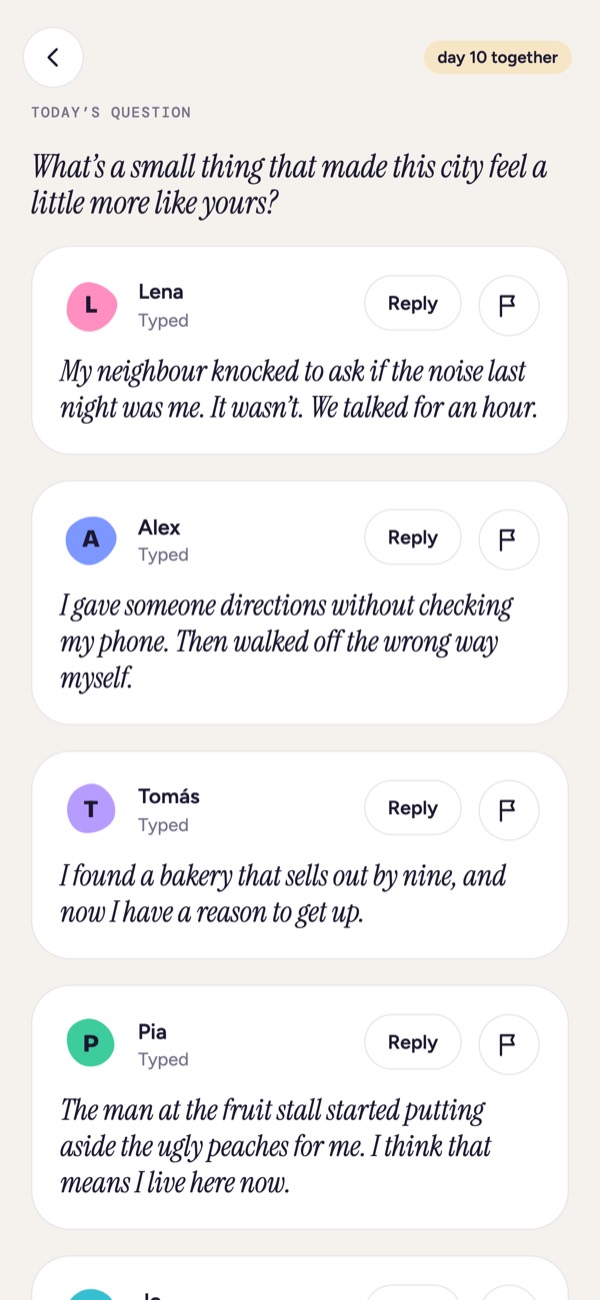
While the local friendships grow, a small online circle gives you people to talk to every day: about six people who want new friends too, the same faces every week, one easy question a day.
- A small circleStillHuman puts you with about six people who stay together.
- One question a dayAn easy reason to talk, every day.
- FreeJoin in a minute with Google.
Questions
Is it normal to have no friends in your 20s?
It’s more common than people admit, especially after school or university ends or after a move. The structure that made friendship automatic disappears, and it takes deliberate, repeated contact to rebuild it.
How do you make friends in your 20s after university?
Join one recurring activity with the same people, say yes to second invitations, and be the one who suggests a specific plan. Expect it to take a couple of months.
Where can you meet people in your 20s?
Run clubs, social sports leagues, climbing gyms, classes, volunteering, friends of friends and small online circles all work, as long as you see the same people regularly.
Is StillHuman available in my country?
Yes. StillHuman works in any modern web browser, in English, almost anywhere in the world: North America, the UK and Europe, Australia and New Zealand, India and South Asia, Southeast Asia, Latin America, the Middle East and Africa. You answer the day’s question whenever suits you.

Save this guide for later.
Pin it, or send it to someone who needs it.